Why the em dash will get a vinyl revival, and why your typos won’t save you
Short on time? Skip to the tl;dr.
The em dash on the keyboard
A student of mine recently handed in a piece of writing that was beautiful. Em dashes everywhere, each one sitting exactly where a style guide would want it. When we talked it through, it turned out they couldn’t have told you where to find an em dash on a keyboard — Option-Shift-hyphen on a Mac, for the record.
Nobody was fooled, the student included. The em dash had become a fingerprint, and it wasn’t theirs.
Writers have loved that dash for a long time; Emily Dickinson’s poems are famously full of them. Now it reads as a confession. Slate and The Ringer both felt the need to publish defences of it last year, which is the sort of thing you do for a friend who’s been arrested.
The em dash is only the ringleader. We’ve all built a mental checklist of tells: the tidy rule of three, “it’s not just a product, it’s a movement”, the rhetorical question nobody asked, the relentless optimism of a golden retriever with an MBA, and the neat summary at the end in case you weren’t paying attention. You’ve probably had an email written in that voice this week, and there’s a fair chance you sent one.
I’m hardly innocent. Dig back through my own blog and you’ll find the line “This isn’t just creative laziness–it’s a semiotic prison.” I was writing like a machine before it was fashionable.
So, if perfect has become suspicious, does imperfect become valuable? I think it does, for a while. Where it goes after that surprised me.
The flood
In August, Cloudflare’s CFO Thomas Seifert told investors that “if the current trends continue, we think in five years, non-human traffic will be as much as 1,000 times as much as human traffic“, and that “humans will be a rounding error on the internet”. He opened, to his credit, with “the big caveat that I have called it wrong at every point along the way.”
That’s a forecast, and it’s about traffic: bots and agents fetching pages, not publishing them. But a web where machines do nearly all the reading is unlikely to be one where they do very little of the writing.
The published part is already substantial. Graphite, an SEO firm, ran 65,000 articles through an AI detector and estimated that AI-written articles went from about 5% in 2020 to roughly half, before levelling off. Detectors are crude instruments, so treat the exact figures with suspicion. The direction is hard to argue with.
The more interesting problem is sameness. In a 2024 study in Science Advances, Anil Doshi and Oliver Hauser asked 293 people to write short stories, some with AI-generated ideas to start from. The AI help made individual stories better, especially for the less naturally creative writers. It also made the stories more alike. Each piece improved while the collection got flatter. Scale that up to the whole internet and you can see why everything has started to taste the same.
It also changes who reads you. If agents do most of the reading, more of your writing will reach people as a bot’s summary, with the personality filtered out on the way through.
(As for the famous “90% of online content will be AI-generated by 2026” statistic, Reason traced it back to one 2020 prediction by the CEO of a synthetic-video company, who was talking about video. The hype about the flood is its own kind of slop.)
Generative garbage
In May 2023 I finally got a letter published in The Economist. It was a reply to Yuval Noah Harari’s essay on AI, and the argument was simple: if you want to see the future of a world drowning in generative AI, scroll LinkedIn. LinkedIn and corporate blogs were, as the letter put it, “the future déjà vu of a world dominated by generative AI”. The editors titled it “Generative garbage”, and I was thrilled.
I was also open at the time about how it was made. The observation was mine. ChatGPT helped draft it (“make it funnier”), I edited it and ran it through Grammarly, and The Economist’s editors trimmed it again.
Three and a half years on, the letter has aged in two ways.
The argument turned out to be right, in a slightly grim way. Large language models learned to write by reading the internet, and a big chunk of the internet’s professional prose was already corporate filler. AI slop didn’t invent the LinkedIn voice. It inherited it and put it on a free plan. AI can help someone express a worthwhile thought, and it can just as easily help them produce a beautifully upholstered absence of one.
And the polish that got my letter published would get it binned today. Send the same letter in 2026 and an editor might well smell the machine on it. Polish used to be a credential. Now it’s a question mark.
The backlash has already started
When polish becomes suspicious, writers rough it up.
In July, Wired ran a piece by Emma Madden headlined “More Typos, Fewer Em Dashes: Writers Are Creating an Anti-AI ‘Literary Counterculture’”. Novelists, journalists and, inevitably, power LinkedIn posters are deliberately breaking their own prose: lowercase everything, typos left in, em dashes swapped for full stops and brackets. The mistakes are worn like a badge that says a human was here.
That was my hunch before I’d read a word of it, and there’s a long history behind it.
In 1528 Baldassare Castiglione gave deliberate imperfection a name in The Book of the Courtier: sprezzatura, the art of doing something difficult and making it look like you barely tried. Five hundred years later, every “no-makeup” selfie is still running the same software. The punk zines wore their photocopier grain and wonky lettering with pride, built on the idea that you didn’t need to be good to be worth hearing. Lo-fi musicians kept the tape hiss in on purpose. And online, as the linguist Gretchen McCulloch shows in Because Internet, lowercase has long signalled calm and casual, while a full stop at the end of a text can read as passive-aggressive.
Meanwhile analogue is booming precisely because digital won. In 2022 vinyl outsold CDs in the US for the first time since 1987, and people now pay a premium for crackle.
Every time a medium gets too smooth, someone roughs it up to prove a person was there. It was always going to happen to writing. If anything, it’s late.
Authenticity or idiocy?
Here are two accounts of the same meeting:
The meeting concluded without a decision, and the team agreed to reconvene the following week.
An hour. No decision. Apparently we’re doing it again next week.
Both are clear. The second tells you how the writer feels about the meeting, and the fragments are doing real work. Now misspell “decision”. You haven’t added any insight. You’ve added a misspelling.
That’s the line between authenticity and idiocy, and the behavioural science on it is more fragile than the folklore. The classic study is Elliot Aronson’s 1966 “pratfall” experiment: students listened to a tape of a quiz candidate who either came across as brilliant or as average, and who sometimes spilt coffee over himself at the end. The story you usually hear is that the blunder made the brilliant candidate more likeable and the average one less so. The actual paper is smaller and more careful than that. It involved 48 male students, and the boost for the brilliant candidate wasn’t statistically significant on its own; what mattered was the interaction between competence and the blunder.
Even read cautiously, the lesson holds. A mistake means different things depending on whether the reader already trusts you. A famous tech founder can post in all lowercase and it reads as relaxed confidence. A graduate who sends a job application in lowercase just looks like someone who can’t find the shift key.
There’s a fairness problem too. A lot of my work happens in the Nordics, with people writing in English as a second or third language. Plenty of them write cleaner English than native speakers, because they actually learned the rules. In a world where fluent writers sprinkle in mistakes as an accessory, the people who’d gladly remove their mistakes get penalised for them, while everyone else gets credit for performing informality. To a Nordic reader, a deliberate typo doesn’t say “human”. It says “careless”.
So the line between authenticity and idiocy is thin, and you don’t get to draw it. The reader does.
Why the typo won’t last
The bigger problem is that typos are free.
Biologists call the alternative costly signalling. Roughly: a peacock’s tail is ridiculous, heavy and conspicuous, and it makes him lunch for anything with claws, which is exactly why peahens trust it. Only a genuinely healthy bird can afford to drag that thing around. Rory Sutherland’s Alchemy is the best book I know on how much of business runs on the same logic. A signal stays honest only when it’s expensive to fake.
A typo costs nothing, and neither does lowercase or deleting your em dashes. Anything that costs nothing gets faked.
We’re also worse at spotting the fakes than we think. In a 2023 paper in PNAS, Maurice Jakesch, Jeffrey Hancock and Mor Naaman ran six experiments with 4,600 people judging whether self-descriptions were written by humans or AI. People leaned on unreliable cues, and the researchers then used those very cues to make AI text seem more human than the real thing. The em dash panic is the same mistake at scale. Spotting a mannerism doesn’t tell you who wrote the paragraph, and turning editorial irritation into forensic certainty is an impressive way to be confidently wrong.
The faking is already industrialised. There’s a whole category of “AI humaniser” tools that sand off the machine tics and sprinkle in some human mess, and any model will cheerfully write in lowercase with the odd error if you ask. Every human tell gets learned, copied and burnt out in months. It’s Goodhart’s law with a keyboard: when a measure becomes a target, it stops being a good measure.
We’ve seen this film before, and LinkedIn made it. A few years ago the authentic move was the one-line paragraph and the vulnerable confession, which someone christened “broetry”. (“I cried in a meeting today. Here’s what it taught me about B2B sales.”) It felt raw next to the press-release voice around it, until it became a template and eventually training data. Thomas Frank mapped this pattern back in 1997 in The Conquest of Cool: the counterculture rarely defeats the mainstream; it becomes its raw material. Give the typo trend a year and the brand that used to sound like a press release will sound like a press release that has been instructed to remove its capitals.
That’s where my thinking had got to: imperfection as authenticity is real, but it’s a luxury good with a short shelf life.
Then I remembered a book on my shelf.
The answer was on my bookshelf
For Christmas in 1996 my mum gave me Brian Eno’s diary, A Year with Swollen Appendices. It had only just come out and was really hard to find, so she had to order it online, which in 1996 was not a simple thing to do.
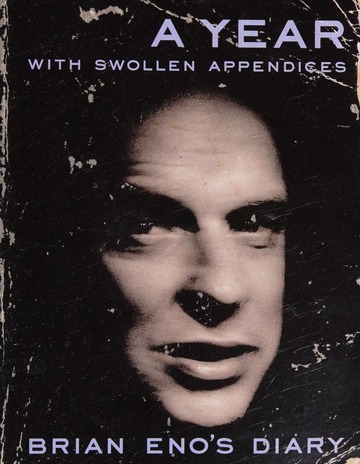
Buried in it is a passage I’ve carried around ever since:
Whatever you now find weird, ugly, uncomfortable and nasty about a new medium will surely become its signature. CD distortion, the jitteriness of digital video, the crap sound of 8-bit – all of these will be cherished and emulated as soon as they can be avoided. It’s the sound of failure: so much modern art is the sound of things going out of control, of a medium pushing to its limits and breaking apart. The distorted guitar sound is the sound of something too loud for the medium supposed to carry it. The blues singer with the cracked voice is the sound of an emotional cry too powerful for the throat that releases it. The excitement of grainy film, of bleached-out black and white, is the excitement of witnessing events too momentous for the medium assigned to record them.
Film grain, vinyl crackle, tape hiss and VHS tracking lines were all faults once, and they’re all filters and presets now. Your phone will happily add grain to a photo taken with a sensor that would make a 1970s cinematographer weep.
The obvious way to use Eno here is the one I started with: human imperfection as the authentic signature against AI’s perfection, with typos as tape hiss. But read it again. Eno is talking about the flaws of the new medium, and the new medium here is the machine.
The machine has plenty of flaws. In text, it’s the em dash and its friends. In images, it’s the six-fingered hand and the shop signage that melts into alphabet soup. They’re embarrassing today, but look at Eno’s last few words: “as soon as they can be avoided.” Once the models can avoid their tells, the tells become a choice, and a choice can become a style.
That has already started. In March 2023 someone used an early text-to-video tool to make a clip of Will Smith eating spaghetti. His face melted and the pasta did things pasta shouldn’t. It went viral, became the benchmark every AI video model has been tested against since, and in 2024 Will Smith posted his own parody. The failure became the signature.
Then in 2025 came Italian brainrot: deliberately absurd AI-generated creatures like Tralalero Tralala, a shark in trainers, narrated in fake Italian. It’s now trading cards and Roblox games. Ask anyone under twelve. The weirdness of the machine is the bit they love most.
So my prediction, made with all the confidence of a man who’ll never be held to it, is that your kids will write like ChatGPT on purpose. Sometime in the 2040s a band will release an album with liner notes written in pitch-perfect 2024 chatbot, and a fashion brand will run a campaign in that breathless, em-dash-heavy voice, the way brands now use 8-bit graphics and VHS fuzz. “Delve” will come back ironically and then, terrifyingly, sincerely.
Today’s slop is tomorrow’s chiptune.
And we’ll love those flaws for exactly the reason Eno gives. The six-fingered hand is the sound of failure: a machine pushing past what it can do and visibly breaking. It’s the distorted guitar of image generation, and that’s the clue to everything else in this post.
Visible effort, not visible error
Eno explains why we love these flaws in the lines that follow. The distorted guitar is “something too loud for the medium supposed to carry it”. The cracked voice is “an emotional cry too powerful for the throat that releases it”. The flaws he loved weren’t random errors. They were evidence that something big was pushing against the limits of the medium: force and strain, made audible.
A typo is evidence of very little apart from haste, which is why it won’t last. What readers are actually hunting for is effort.
Go back to that Christmas. I still remember that book thirty years later partly because of Eno, but mostly because my mum went to real trouble to get it. The effort was the gift. And what took me thirty years to notice is that I only know about the effort because she told me. If she’d gone to all that trouble and said nothing, it would have been a nice book. Because she told me, it became a gift with a story attached. As far as signalling goes, invisible effort is wasted effort.
Behavioural science backs this up. In 2011 Ryan Buell and Michael Norton at Harvard Business School published “The Labor Illusion”. They built travel-search sites that either returned results instantly or made people wait while showing the work: searching this airline, now that one, comparing fares. People valued the slow, transparent search more, and many preferred it to the instant one even when the results were identical. It’s the logic of every open kitchen.
Justin Kruger and colleagues found something similar with art in 2004: tell people a painting took 26 hours rather than four and they rate it higher. A 2023 replication found the painting effect held up, more weakly, while a companion study with a poem gave mixed results. The evidence is patchy, but it points the same way as the labour illusion: when we can’t easily judge quality, we lean on signs of effort.
That doesn’t mean polish is dead. Cheap polish is dead. A beautifully typeset book, a handwritten card or an edit that’s obviously been sweated over still reads as effort, because it still costs something. The machines have made polish free, but they haven’t made care free.
So stop trying to look less polished. The useful question, for anyone who writes to earn a living or win business, is how to make the effort visible.
The hole in my own argument
Visible effort can be faked too.
The labour illusion is, after all, an illusion. Some of those “searching 400 airlines…” progress bars are pure theatre, and AI will happily invent drafts, sources, process notes and heart-warming anecdotes about somebody’s mum.
And some readers simply prefer the machine. In a 2024 study in Scientific Reports, Brian Porter and Edouard Machery found that non-expert readers couldn’t tell AI poems from poems by famous poets, and rated the AI ones more highly, apparently because they were easier to understand. Tell people a poem was AI-generated, though, and they liked it less. The text didn’t change. Their beliefs about where it came from did.
That’s the real point. The signals that survive are the ones that cost a faker as much as they cost you: your name on an opinion that could turn out to be wrong, specifics a reader can check, and relationships with people who know you well enough to notice if you started faking it. Call it skin in the game.
My mum’s book is a good test. A model can produce a plausible, even moving, memory of receiving an obscure book for Christmas. Whether it happened is a separate question, and it’s one I’m responsible for when I put my name on it.
So what?
First, a sanity check. Most writing doesn’t need any of this. Nobody wants authenticity from a train timetable, a privacy policy or the instructions for a flat-pack wardrobe. Clear and correct is the whole job there, and if a machine does it, good. AI should do the boring bits so humans can do the interesting bits.
It matters wherever trust is the point: anything with your name on it, anything trying to persuade, and anything that’s part of a relationship. It matters most where a person is still reading you directly rather than through an agent’s summary. Those moments are getting rarer, which makes them worth more.
If you lead a team or run a brand, a few things follow.
Stop fighting the surface. Tone-of-voice guidelines that ban em dashes and the word “delve” are a fix for last month’s tell, and the machines will have learned next month’s before you’ve written it down.
Show the working instead: the research behind a claim, the people you actually spoke to, the drafts, even the prompts. When I published how my Economist letter was made, I didn’t think of it as a signal, but it was. The letter hid the effort and the blog post showed it.
Put a name on it. Founder notes and signed opinions carry weight because someone stands to look foolish if they’re wrong. Committee-safe copy signed by “the team” carries none.
Get specific. Machines produce the average of everything, so specificity is evidence that somebody went looking. That’s my copy of Eno’s diary at the top of this post. A machine can write about a hard-to-find book, but it can’t have been given one.
If you want something to do on Monday, take the last thing you published and ask where a reader could see the effort. If the answer is nowhere, a typo won’t save it.
Typos are cheap
In 2023 I said the idea was the best bit of my Economist letter, and that bit was mine. I still think so, but it was incomplete. An idea with no visible effort behind it looks exactly like one a machine produced in four seconds. Three years later, I suspect the blog post about the prompts was more human than the letter.
Eno’s flaws were the sound of something too big for the medium. In a world of infinite, frictionless, perfectly punctuated text, the equivalent is writing that visibly cost someone something, whether that’s the research, the nerve to be wrong in public, or a mum ordering a hard-to-find book for her son in 1996.
Typos are cheap and thinking isn’t. I’d hate to see us spend all this effort teaching machines to write badly while we carry on having nothing to say.
//A ✍️
tl;dr (yes, I know)
→ AI has made polished writing cheap and increasingly samey, so polish has stopped meaning much. Clean prose now triggers one question: is this AI?
→ Cloudflare forecasts that bot traffic could be 1,000 times human traffic within five years. A web that machines mostly read will be one they increasingly write.
→ Writers are fighting back with typos, lowercase and a ban on the em dash. It’s an old trick that works briefly, mostly for people whose competence is already beyond doubt.
→ It won’t last. Typos cost nothing to fake, and our instincts for spotting AI are unreliable anyway.
→ Brian Eno predicted the twist in 1996: a new medium’s flaws become its cherished signature. This time the flaws belong to the machine. Will Smith’s spaghetti and Italian brainrot suggest it’s already happening.
→ What survives is visible effort, not visible error, and the strongest kind comes with skin in the game: your name, checkable specifics, real relationships.
→ Cheap polish is dead. Care isn’t. Show your working.
Further reading
Brian Eno, A Year with Swollen Appendices (Faber, 1996). The full “sound of failure” entry: Diaries of Note
The Register: “Humans will be a rounding error on the internet” (August 2026)
Graphite: AI now writes as many online articles as humans (2025)
Doshi & Hauser, “Generative AI enhances individual creativity but reduces the collective diversity of novel content”, Science Advances (2024)
Reason: tracing the “90% of content” statistic (2023)
Emma Madden, “More Typos, Fewer Em Dashes”, Wired (July 2026)
Aronson, Willerman & Floyd, “The effect of a pratfall on increasing interpersonal attractiveness”, Psychonomic Science (1966)
Jakesch, Hancock & Naaman, “Human heuristics for AI-generated language are flawed”, PNAS (2023)
Rory Sutherland, Alchemy (2019)
Buell & Norton, “The Labor Illusion”, Management Science (2011)
Kruger et al., “The Effort Heuristic”, Journal of Experimental Social Psychology (2004), and the 2023 replication
Porter & Machery, “AI-generated poetry is indistinguishable from human-written poetry and is rated more favorably”, Scientific Reports (2024)
The Will Smith Eating Spaghetti test and Italian brainrot
Baldassare Castiglione, The Book of the Courtier (1528); Gretchen McCulloch, Because Internet (2019); Thomas Frank, The Conquest of Cool (1997)
My Economist letter and how it was made: adamhorne.com/economist-letter